Translate

Showing posts with label almond butter. Show all posts

04 January 2014

Ninja, a re-enactment

I finally got around to doing the re-enactment of the Ninja™ Master Prep™ Professional peanut butter video (available on YouTube).

I must say, the results were quite eye-opening.  First, using the oil created a more liquid product than I got from using the almonds.  The problem with that is the final result wasn't so much peanut butter as peanut soup.  In fact, it is still quite liquid after being in my refrigerator for about a week now.  So, the demonstration was accurate to a point.  What I need to do now is adjust the proportion of nuts to oil, and I should be able to create more nut butters.

As always, I welcome your comments.  Click on the Comment link below; it may say "No" or have a number in front of it.

17 December 2013

Ninja almond butter test

I am testing the Ninja™ Master Prep™ Professional (their italics, not mine), the ultimate food and drink maker, model #QB1004 30.  In this post, I am specifically using the “bowl”, the smallest unit of this 3-unit set.  This is the piece used in the YouTube video to make peanut butter.  I am going to attempt the same thing with various types of nuts.

Because my first interest is almonds, my first test was with blanched slivered almonds.  I put 1 cup (140 grams) of slivered almonds into the bowl with the 4-blade stem and ran the machine.  At first, it did not seem to do anything beyond pulverize the almonds.  At least, however, I could see the mass moving around the bowl, which is more than I saw with my food processor.  Unfortunately, after several minutes and some really awful squealing coming from the bowl, I still did not have nut butter.  I decided to try something.  I put in a few shots of olive oil and began pulsing the machine.  Sure enough, it started to coalesce into something resembling butter.
Upon tasting it, though, the texture was not the creamy peanut butter we know and love; it was more like an almond pâté or paste, quite akin to marzipan.  Trying several more pulses of the machine didn't improve the texture much.  Since the machine already smelled like it was burning, I decided to end the experiment.  I do have a usable almond pâté, but the machine did not create true almond butter.  How would it spread on bread?
You can really see here the coarseness of this “butter”.  I am spreading it on toast because one of my pre-exercise snacks calls for almond butter on whole wheat toast.
I am not sure if you can see, but the middle of the toast did get kind of squashed while trying to spread the pâté; I'm almost afraid to try it on untoasted bread.  Although usable for my purpose, I wondered if I could improve on the texture, so I decided to re-create the YouTube experiment exactly. First, though, I have to go out and buy a can of peanuts.  The results blog is now available for viewing.

As always, I welcome your comments.  Click on the Comment link below; it may say "No" or have a number in front of it.

14 December 2013

Ninja Master Prep Pro has arrived!

The Ninja™ finally arrived!
This is the Ninja™ Master Prep™ Professional (their italics, not mine), the ultimate food and drink maker, model #QB1004 30.  (There is a model #QB1004CO 30, but I have yet to find the difference.)  Unfortunately, the Ninja™ is made in China, which accounts for it being the second-least-expensive food processor I could find.  (Note, there are less expensive food choppers, including the Ninja™ food chopper.  However, this was the least-expensive machine I could find that would make peanut butter.)  This set comes with the following parts:
This is what is called the “master pod” or “power head”.  It is the motor part of the machine, what would be the bottom of a normal blender.  It has only one button.  The large silver piece, off of which my flash is reflecting, is a pulsing switch.  Press it, and the motor runs.  Release it, and the motor stops.  The Ninja™ website states that the motor should never be run more than 20 seconds at a time, although the owner’s guide puts it at 15 seconds.  Longer stints could burn out the motor.  By the way, this is the only part that CANNOT BE PUT IN A DISHWASHER; all other parts are top-shelf dishwasher safe.
This is the pitcher splash guard.  It is designed to be used with the 2 pitchers that accompany this set.  One places it on top of the pitcher and then places the motor on the splash guard.  The guard has an “easy-flip” pour spout that can be opened to pour drinks.
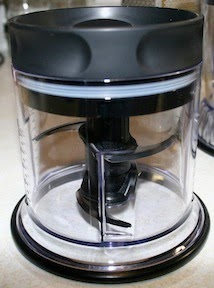
This is the bowl.  It holds up to 2 cups, has 4 blades, and comes with its own splash guard.  The blade shaft can be separated into 2 pieces, although there is no explanation in the owner’s guide as to why.  I suppose it is in case you have more stuff to chop.  The owner’s guide also says to never put in more than 2 cups of dry or 1 cup of liquid ingredients.  This piece is what was used in the YouTube video to make peanut butter.  In the video, peanut butter is achieved within 54 seconds, although they do run the machine a second time to get a creamier texture.
This is the smaller of the 2 pitchers.  It holds 40 ounces.  The blade shaft is removable, but it does not separate into 2 piece, like the bowl blade does.
This is the larger of the 2 pitchers.  It holds 48 ounces and has a single-piece 6-blade shaft.  Each of the pitchers comes with a Tupperware®-style cover.  It can, thus, be used for storage when the blade is removed.  All three bowls have a rubberized bottom to prevent slippage when the motor is running, although one should always keep a firm grip in the machine while in operation (so warns the owner’s guide).
The paperwork that comes with the machine consists of a yellow blade warning, a request to call with problems instead of returning the machine, a quick start guide with 1 recipe for each bowl/pitcher, and the owner’s guide.  (I have created a searchable .pdf file of the owner’s guide, which is COPYRIGHT © EURO-PRO OPERATING LLC 2010, and have saved it here.)  The recipes are a coffee-chocolate smoothie without ice, fresh tomato salsa, and “onion chop”, which is basically a tutorial on chopping an onion.  The owner’s guide is 16 pages long, with 2 of these pages being the registration card to cut off and mail to Canada.  (I wonder if I need an international stamp for that.  Well, I have to make a trip to the post office anyway.)

So, now all that there is left to do is wash the machine.  Upon putting the parts into my dishwasher, I discovered this . . .
That is how little space I have between the top of the larger pitcher and the inside of my dishwasher, so caveat emptor that it may not fit in the top shelf of your dishwasher.  Now, on to the peanut butter test!

As always, I welcome your comments.  Click on the Comment link below; it may say "No" or have a number in front of it.

08 December 2013

Almond Butter, test #1

I started with 360 grams (12¾ oz) of raw almonds, which measured to approximately 2½ cups.  After blanching and peeling the almonds, I put them in my Black & Decker food processor with the chopping blade and let her rip.

The first thing I need to add to the recipe card is earplugs.  That thing was loud!  The nuts got to the first stage, powdered, nicely within about 5 minutes.  After several scrapings of the bowl, though, nothing more seemed to happen.  The powder was not moving.  I shook the processor to get the powder to fall into the blade, but it appeared to just be thrown out again.  I ran the processor for a total of 35 minutes with no progression to the second stage.

To see if making butter was even possible with almonds, I poured the entire thing into my Oster Fusion smoothie blender and ran it.  Very quickly the powdered nut at the bottom of the blender butterized.  Unfortunately, there was no movement of the nuts above into the blade, as the butter created a barrier.

Off to the Internet I went to see what my problem could be.  Only two clues presented themselves.  Most of the recipes use roasted nuts and I used raw.  I am not sure if that will make a difference or not.  However, it is something I will have to test in the future.  The other clue is the machines used.  One person was using a $600 KitchenAid food processor; another was using a professional Vitamix blender.  It is a possibility, therefore, that the machine has something to do with the process.

Searching the Internet for an inexpensive food processor that is guaranteed to make nut butter is not an easy task.  Eventually, I just settled on looking at processor prices.  On Target.com, the second-least-expensive food processing system was the Ninja#8482; Master Prep™ Professional (their italics, not mine).  For those of you who do not know, a Ninja is basically a blender with the motor at the top instead of the bottom.  The containers also come with multiple blades.  The question, then, was would this machine make a nut butter.  Thank God/Gaia/Zeus/Odin/Cthulhu for YouTube.  Somebody actually posted a video of them making peanut butter using the Ninja™.  It took under a minute, although they did use an oil to speed the process.  Because of this video, I wrote to the company to ask if the machine did, indeed, make peanut butter.  They replied that they could not guarantee it since the machine was a chopper and not a food processor.  The video and the price convinced me to give it a try.  I am really hoping it works, because I can then replace two countertop machines with one that fits into a cabinet.

I have placed my order with Target, which had a $10 lower price than Wal*Mart, and got a 2-year Target warranty just in case I blow out the motor making nut butters.  Since it does have a blender pitcher, I will also attempt to use it to make my smoothies; they advertise the machine can make snow from ice cubes.  It is supposed to arrive around the 12th.  At that time, I will be able to get the ingredients for test #2.

As always, I welcome your comments.  Click on the Comment link below; it may say "No" or have a number in front of it.

Almond Butter, the recipe

After looking through many almond butter recipes on the Internet and in cookbooks, I have made a few decisions regarding my almond butter:

  • No added oil if at all possible
  • Peel the nuts so skins aren't floating in the butter
  • Some sort of additional sweetener is acceptable

Therefore, I have decided to use the recipe from A Full Measure of Happiness as my base.  It has only 3 ingredients:  Nuts, salt, and honey.  Honey, in addition to being sweet, has many health benefits, though I may switch to molasses in the future due to its high concentration of minerals.  This also adds some liquid to the mixture, so I hope that will provide lubrication to the food processor  At this point, then, we have ingredients of:

  • 2 cups almonds, blanched and peeled
  • ¼ tsp. salt
  • ¼ cup honey

It is on to test the recipe.

As always, I welcome your comments.  Click on the Comment link below; it may say "No" or have a number in front of it.

References:

To Blanche or Not To Blanche?

An interesting piece of information I came across while researching making almond butter was the fact that nuts have something called phytic acid.  Phytic acid is an anti-nutrient because it blocks the absorption of minerals in the digestive tract (Bravo), especially zinc, calcium, and iron (Zhou) as well as magnesium (Curcio; Bravo).  This is not just a nut problem; it seems phytic acid is in most of the foods we consume, from nuts to grains to seeds to soy to corn (Rose).  According to registered dietitian Peter Curcio, there are both bad and good sides to phytic acid.  Yes, studies have shown it binds to minerals, but they have also shown phytic acid to have cholesterol and glycemic benefits as well as some cancer-fighting properties.  This is echoed by Zhou and Erdman.

Most of the phytic acid in almonds is contained within the skin (Cottis), so blanching and peeling decreases the phytic acid content.  The nuts could also be soaked and peeled (Cottis), which is also known as “activating the nut”, or sprouted (Curcio).  Grains and legumes can also have their phytic acid content reduced by performing soaking or sprouting (Zhou).

In actuality, then, it comes down to taking the bad with the good or removing the skin.  Personally, I don't like the pictures on the Internet of almond butter with these pieces of skin floating in it.  For that reason, I have chosen to proceed with a blanched almond butter recipe.

As always, I welcome your comments.  Click on the Comment link below; it may say "No" or have a number in front of it.

References:

Bravo, Monica. “Naked Almond Butter Recipe.” Bravo For Paleo. N.p., 4 Sep. 2013. Web. 8 Dec. 2013.

Cottis, Halle. “Organic Blanched Almond Butter Recipe.” Whole Lifestyle Nutrition. Whole Lifestyle Nutrition, 16 Sept. 2013. Web. 7 Dec. 2013.

Curcio, Peter. “Dissecting Anti-Nutrients: The Good and Bad of Phytic Acid.” Breaking Muscle. Breaking Muscle, 11 Dec. 2012. Web. 8 Dec. 2013.

Rose, Amanda. “Phytic Acid: Tips For Consumers From Food Science.” Phytic Acid. Phytic Acid, n.d. Web. 8 Dec. 2013.

Zhou, Jin R., and John W. Erdman Jr. “Phytic acid in health and disease.” Critical Reviews in Food Science and Nutrition 35.6 (1995): 495-508. Print.

07 December 2013

Almond Butter, the process

The process to make almond butter, or any nut butter for that matter, is fairly simple:  Grind nuts until liquified, add seasonings and/or flavorings as desired, add oil if using a machine and are impatient.  Some sources say to use roasted almonds (Carduff), while others suggest it is healthier to use blanched almonds (Cottis).  One consistency between recipes is that the nuts are unsalted.  Either way, that is all there is to it.

But how, you may ask, does that solid nut turn into liquid gold.  The idea is to crush the nuts so finely that they release their oils.  Mixing the now-released oils with the powdered nut results in the texture we know as butter.  This is why some recipes include small amounts of oil.  It is kind of like priming a pump.  The oil helps the processor chop the nuts, which then release their own oils to continue the process.  There is also the claim that adding an oil will result in a creamier end product (Annie).  There are actually recognized stages the nuts will go through:  Powdered, clumping, grainy, and smooth (Gilmore, Heather).  As almonds are harder nuts, these are said to take upwards of 30 minutes of constant processing to create almond butter.  I have, however, discovered video of peanut butter done in under 1 minute.

I have also discovered two pieces of information that you will be hard pressed to find on any of the other blogs and websites concerning almond butter.  The first is that the machine is key.  Having a cheap machine will result in failure, as you can read about in a subsequent post.  The second is that no matter how long you run the machine, you will still have chunks.  I'm not talking whole nuts, but the resulting product will be grainier than store-bought butter.  As long as you understand these two caveats and have some time and earplugs, you are ready to proceed.

As always, I welcome your comments.  Click on the Comment link below; it may say "No" or have a number in front of it.

References:

Annie. Weblog comment. Homemade Nut Butter. Heather Eats Almond Butter, n.d. Web. 7 Dec. 2013.

Carduff, Elizabeth, Julia Collin Davison, Louise Emerick, and Dan Zuccarello, ed. The America's Test Kitchen Do-It-Yourself Cookbook. Brookline, MA: America's Test Kitchen, 2012. Print

Cottis, Halle. “Organic Blanched Almond Butter Recipe.” Whole Lifestyle Nutrition. Whole Lifestyle Nutrition, 16 Sept. 2013. Web. 7 Dec. 2013.

Gilmore, Megan. “How To Make Homemade Almond Butter.” The Detoxinista. Detoxinista, 21 Sept. 2012. Web. 7 Dec. 2013.

Heather. “Homemade Nut Butter.” Heather Eats Almond Butter. N.p., n.d. Web. 8 Dec. 2013.

05 December 2013

Almond Butter, the why

The big question is, of course, why make almond butter.  The answer is simply frugality.  Making almond butter costs pennies per ounce, while buying a jar in the grocery store can cost dimes, or even dollars.  There is a big savings to be had by making almond butter at home.  According to one source, a cup of home-made almond butter costs approximately $3.75, while supermarket brand MaraNatha comes in at $6.40 a cup (Reese).  At a savings of $2.65 per cup, I would need to make 22.2 cups of almond butter to pay for my new food processor (Ninja).  At 2 tablespoons per day (1 with breakfast and 1 in my smoothie) 6 days a week (when I am exercising), my savings start in the 30th week.

Another benefit is creating personal mixtures.  How about macadamia almond or peanut pecan?  The possibilities are endless.  Those are a couple good reasons to try making almond butter at home.

A third benefit is control of ingredients.  That MaraNatha almond butter contains added sugar and palm oil, which is 50% saturated fat and increases the risk of heart disease (Robb-Nicholson).  Other sites insist palm oil production is bad for the planet due to rainforest deforestation and orangutan habitat loss (Thompson) as well as use of child labor (Skinner).

The fourth, and most important in my humble opinion, is the right so say “I made it.”  I am so tired of hearing people say “Can't you just buy that?”  When the world collapses, you can come to me when you want some peanut butter, okay?

Now thoroughly self-convinced that making almond butter has value, it is on to looking into the process.

As always, I welcome your comments.  Click on the Comment link below; it may say "No" or have a number in front of it.

References:

"Ninja Master Prep Professional-Black/Silver." Target. Target Brands, Inc., n.d. Web. 5 Dec. 2013.

Reese, Jennifer. Make the Bread, Buy the Butter: What You Should (and Shouldn't) Cook from the Scratch to Save Time and Money. New York: Free Press, 2012. Print.

Robb-Nicholson, Dr. Celeste. “By the way, doctor: Is palm oil good for you?.” MSN Healthy Living. Microsoft, 7 Oct. 2013. Web. 5 Dec. 2013.

Skinner, E. Benjamin. “Indonesia's Palm Oil Industry Rife With Human-Rights Abuses.” Bloomberg Businessweek (businessweek.com). Bloomberg L.P., 18 July 2013. Web. 5 Dec. 2013.

Thompson, Claire. “Palm oil: Bad for workers as well as orangutans.” Grist. Grist Magazine, Inc., 25 July 2013. Web. 5 Dec. 2013.

Almond Butter, an introduction

Two of the recipes I am experimenting with for my exercise program include almond butter.  Well, one uses almond butter and the other uses nut butter.  I enjoy almonds, so I might as well use almond butter.  When one searches the Interweb, one finds hundreds of easy-to-make recipes for almond butter.  It's almonds, salt, and sweetener with optional oil.  Put it all in a food processor.  Viola, you have almond butter.  Simple, right?

WRONG!

Apparently, there is more to making a nut butter at home than people are letting on.  Therefore, I will chronicle my adventures with nut butter in a series of blogs.


As always, I welcome your comments.  Click on the Comment link below; it may say "No" or have a number in front of it.