Translate

Showing posts with label Ninja Master Prep Professional. Show all posts

04 January 2014

Ninja, a re-enactment

I finally got around to doing the re-enactment of the Ninja™ Master Prep™ Professional peanut butter video (available on YouTube).

I must say, the results were quite eye-opening.  First, using the oil created a more liquid product than I got from using the almonds.  The problem with that is the final result wasn't so much peanut butter as peanut soup.  In fact, it is still quite liquid after being in my refrigerator for about a week now.  So, the demonstration was accurate to a point.  What I need to do now is adjust the proportion of nuts to oil, and I should be able to create more nut butters.

As always, I welcome your comments.  Click on the Comment link below; it may say "No" or have a number in front of it.

22 December 2013

Ninja: To be fair

Rather than just posting some opinions, I thought I would present a few facts regarding the Ninja™ Master Prep™ Professional.  These facts involve making smoothies with the Ninja&8482;.
This is how a smoothie comes out when made in the Ninja™.  As you can see from the picture, it is a very chunky mix.  This has more of the texture of a shake than a smoothie.  Now, it is possible that one could get the texture smoother by running the motor longer, but that is frowned upon by the user's guide.
This is how a smoothie comes out of my Oster Fusion smoothie blender.  On comparison, the Oster creates a smoother beverage.  To be fair, a bit of the Oster smoothie is air.  By the time the smoothie deflated, both machines made about the same volume of beverage.

Based on these photos and the resulting volume, it becomes a matter of texture.  The Oster makes a smoothie; the Ninja™ makes more of a shake.  To me, that really does not constitute a deal breaker for the Ninja™.  I have other reasons to not like the Ninja, which I have enumerated in my other Ninja&8482; review posts.

As always, I welcome your comments.  Click on the Comment link below; it may say "No" or have a number in front of it.

17 December 2013

Ninja almond butter test

I am testing the Ninja™ Master Prep™ Professional (their italics, not mine), the ultimate food and drink maker, model #QB1004 30.  In this post, I am specifically using the “bowl”, the smallest unit of this 3-unit set.  This is the piece used in the YouTube video to make peanut butter.  I am going to attempt the same thing with various types of nuts.

Because my first interest is almonds, my first test was with blanched slivered almonds.  I put 1 cup (140 grams) of slivered almonds into the bowl with the 4-blade stem and ran the machine.  At first, it did not seem to do anything beyond pulverize the almonds.  At least, however, I could see the mass moving around the bowl, which is more than I saw with my food processor.  Unfortunately, after several minutes and some really awful squealing coming from the bowl, I still did not have nut butter.  I decided to try something.  I put in a few shots of olive oil and began pulsing the machine.  Sure enough, it started to coalesce into something resembling butter.
Upon tasting it, though, the texture was not the creamy peanut butter we know and love; it was more like an almond pâté or paste, quite akin to marzipan.  Trying several more pulses of the machine didn't improve the texture much.  Since the machine already smelled like it was burning, I decided to end the experiment.  I do have a usable almond pâté, but the machine did not create true almond butter.  How would it spread on bread?
You can really see here the coarseness of this “butter”.  I am spreading it on toast because one of my pre-exercise snacks calls for almond butter on whole wheat toast.
I am not sure if you can see, but the middle of the toast did get kind of squashed while trying to spread the pâté; I'm almost afraid to try it on untoasted bread.  Although usable for my purpose, I wondered if I could improve on the texture, so I decided to re-create the YouTube experiment exactly. First, though, I have to go out and buy a can of peanuts.  The results blog is now available for viewing.

As always, I welcome your comments.  Click on the Comment link below; it may say "No" or have a number in front of it.

16 December 2013

Ninja smoothie test

I am testing the Ninja™ Master Prep™ Professional (their italics, not mine), the ultimate food and drink maker, model #QB1004 30.  In this post, I am specifically using the 48-ounce pitcher, the largest unit of this 3-unit set.  This is the 6-blade container the company claims can turn ice into snow, so I am going to try it on a frozen banana smoothie.

At first, I thought the 6-blade design would interfere with the frozen bananas, but the slipped between the blades just fine.  The other ingredients include milk, cocoa powder, and ground almonds.  To see the recipe, click this link.

I pulsed the machine and had an immediate problem.  Liquid squirt out of the splash guard's covered pour spout.  How can such a design flaw not have been noticed this long?  What, did they design it just to make snow and not smoothies?  Immediately disappointed with the machine, I pulsed a few more times to get the frozen bananas chopped up.  I then ran the machine for about 15 seconds and then again for about 15 seconds. I noticed there was still some frozen banana floating in the mixture, so I ran it a third and fourth time.  After this, there appeared to be no more banana floating in the shake.

The first thing I noticed looking through the clear plastic of the pitcher was that the mixture was not very frothy.  It did not seem to have gained any volume, which the recipe does in my Oster Fusion smoothie machine.  Well, that just means it won't deflate during transport, which I consider a benefit.  On pouring out the smoothie, I noticed it had a thick lumpy texture.  These weren't clumps of anything; it just poured lumpy.  This is just an observation, not a complaint.

Drinking the smoothie through a straw produced two observations.  The first was that the texture was more like a shake than a traditional smoothie.  I like shakes, so I did not consider this a failure, only a difference.  The second observation was that there were still chunks of almond remaining in the drink.  With claims of making snow from ice, I consider the presence of almond chunks to be a failure on the part of the machine.

For clean up, it felt much easier than the Oster Fusion.  There was nothing to unscrew, there was no gasket to deal with, and there were fewer overall parts.  The hardest part to clean was the 6-blade stem.  I think I will buy a brush to make it easier next time.  I did notice another design flaw, however.  For people using a dishwasher to clean the Ninja™, there are many nooks and crannies in the larger parts where water will accumulate.  In fact, the entire bottom of the pitcher is recessed.  This, and the splash guard, will fill with water during the washing process.  You will have to wipe them out even after dishwashing.

Overall, the result of using a Ninja™ to make a smoothie are disappointing but not a real failure.  The consistency of the final product is more like a shake than a smoothie.  The two glaring problems are the remaining chunks of nut, which can possibly be fixed by running the machine more, and the leakage from the splash guard pour spout during operation.  That, more than anything else, make me want to go back to using my Oster Fusion.

As always, I welcome your comments.  Click on the Comment link below; it may say "No" or have a number in front of it.

14 December 2013

Ninja chopper test

I am testing the Ninja™ Master Prep™ Professional (their italics, not mine), the ultimate food and drink maker, model #QB1004 30.  In this post, I am specifically using the “bowl”, the smallest unit of this 3-unit set.  It is basically meant to be used as a chopper, as in chopping onions, so that is what I used to test it.
Here you can see the chopper bowl with 3 ounces of red onion in it.  The first two things I noticed that aren’t really in the owner’s guide are the difficulty of assembly of the unit.  The guide simply says, “Place the splash guard on the bowl.” What it does not say is there is only one way the splash guard will fit.  Without this information, I tried to push the splash guard into place.  It took me several tries before I realized the splash guard must be turned to align with parts of the bowl before it will fit in place.  I also could not get the power head to fit onto the splash guard.  After the problem with the splash guard, I decided to keep rotating the power head until it fit into place.  Therefore, there is a mark against the Ninja™ for omissions from the owner’s guide.

With the onions, blades, splash guard, and power head in place, I pulsed the unit 4 times.
If you look closely at the picture, you will see a few larger chunks in the upper portion of the picture.  What you cannot really see is the onion at the bottom of the bowl is almost liquified.  This may diminish as the blades dull with use, but it is definitely too much power to simply chop an onion.  Also, no matter how hard I tried, I could not get all the onion pieces out of the machine and into my dish.
Upon adding the chopped onion to my dish, I discovered more nonuniform pieces, as pictured above.  The smaller nearly liquified pieces browned so quickly in my sauté pan they almost burned, while the larger pieces remained on the raw side.  Had I not been raised eating raw chopped onion as a child, this may have bothered me more than it did.

In conclusion, the Ninja™ is a powerful machine with some frustrating instruction flaws.  Its performance on chopping is simultaneously overzealous and inconsistent.  Given the choice between using a chef’s knife and assembling and washing 4 machine parts, the waste (albeit small), and having to use a chef’s knife to make the onion small enough to fit the machine anyway, I will select the knife over the Ninja™ every time, at least for chopping onions.  Garlic might be another story, though.

The next test I will perform will be of the 48-ounce pitcher to make a smoothie-style drink.

As always, I welcome your comments.  Click on the Comment link below; it may say "No" or have a number in front of it.

Ninja Master Prep Pro has arrived!

The Ninja™ finally arrived!
This is the Ninja™ Master Prep™ Professional (their italics, not mine), the ultimate food and drink maker, model #QB1004 30.  (There is a model #QB1004CO 30, but I have yet to find the difference.)  Unfortunately, the Ninja™ is made in China, which accounts for it being the second-least-expensive food processor I could find.  (Note, there are less expensive food choppers, including the Ninja™ food chopper.  However, this was the least-expensive machine I could find that would make peanut butter.)  This set comes with the following parts:
This is what is called the “master pod” or “power head”.  It is the motor part of the machine, what would be the bottom of a normal blender.  It has only one button.  The large silver piece, off of which my flash is reflecting, is a pulsing switch.  Press it, and the motor runs.  Release it, and the motor stops.  The Ninja™ website states that the motor should never be run more than 20 seconds at a time, although the owner’s guide puts it at 15 seconds.  Longer stints could burn out the motor.  By the way, this is the only part that CANNOT BE PUT IN A DISHWASHER; all other parts are top-shelf dishwasher safe.
This is the pitcher splash guard.  It is designed to be used with the 2 pitchers that accompany this set.  One places it on top of the pitcher and then places the motor on the splash guard.  The guard has an “easy-flip” pour spout that can be opened to pour drinks.
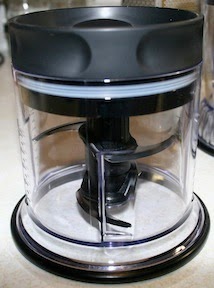
This is the bowl.  It holds up to 2 cups, has 4 blades, and comes with its own splash guard.  The blade shaft can be separated into 2 pieces, although there is no explanation in the owner’s guide as to why.  I suppose it is in case you have more stuff to chop.  The owner’s guide also says to never put in more than 2 cups of dry or 1 cup of liquid ingredients.  This piece is what was used in the YouTube video to make peanut butter.  In the video, peanut butter is achieved within 54 seconds, although they do run the machine a second time to get a creamier texture.
This is the smaller of the 2 pitchers.  It holds 40 ounces.  The blade shaft is removable, but it does not separate into 2 piece, like the bowl blade does.
This is the larger of the 2 pitchers.  It holds 48 ounces and has a single-piece 6-blade shaft.  Each of the pitchers comes with a Tupperware®-style cover.  It can, thus, be used for storage when the blade is removed.  All three bowls have a rubberized bottom to prevent slippage when the motor is running, although one should always keep a firm grip in the machine while in operation (so warns the owner’s guide).
The paperwork that comes with the machine consists of a yellow blade warning, a request to call with problems instead of returning the machine, a quick start guide with 1 recipe for each bowl/pitcher, and the owner’s guide.  (I have created a searchable .pdf file of the owner’s guide, which is COPYRIGHT © EURO-PRO OPERATING LLC 2010, and have saved it here.)  The recipes are a coffee-chocolate smoothie without ice, fresh tomato salsa, and “onion chop”, which is basically a tutorial on chopping an onion.  The owner’s guide is 16 pages long, with 2 of these pages being the registration card to cut off and mail to Canada.  (I wonder if I need an international stamp for that.  Well, I have to make a trip to the post office anyway.)

So, now all that there is left to do is wash the machine.  Upon putting the parts into my dishwasher, I discovered this . . .
That is how little space I have between the top of the larger pitcher and the inside of my dishwasher, so caveat emptor that it may not fit in the top shelf of your dishwasher.  Now, on to the peanut butter test!

As always, I welcome your comments.  Click on the Comment link below; it may say "No" or have a number in front of it.